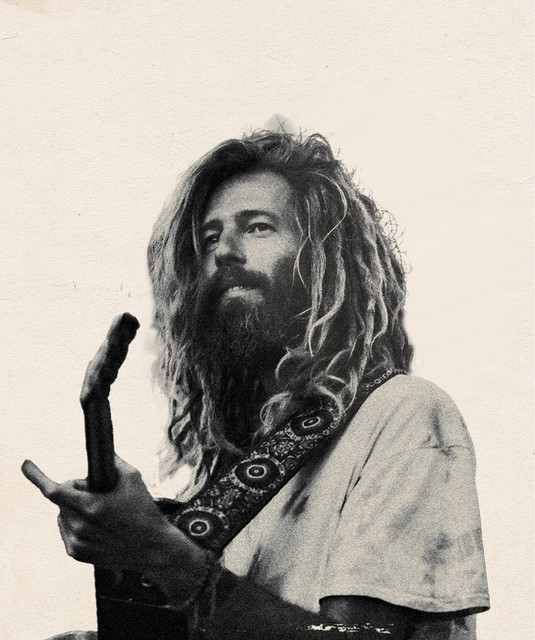
Sam Garrett releases an original song that weaves together themes of inner light, emotional resilience, and a paradoxical love—one that holds without clinging. The song uses water imagery, the metaphor of being "stoned" (grounded and present), and direct philosophical statements ("you are the light") to explore how presence with another person can anchor us even when we're lost, and how emotional flexibility—bending rather than breaking—enables genuine connection.
What Does It Mean to Be "Stoned" in a Song About Presence?
The opening hook—"When I'm stoned and you talk that way"—sets a tone of grounded presence. The term "stoned" here is not a reference to intoxication but to a state of rootedness, a kind of meditative settledness. When the speaker is in this grounded state, the other person's voice, their manner of speaking, becomes a source of comfort: "make me feel so good. Make me feel okay." This establishes a core dynamic of the song: presence with another person as a healing force, not through distraction or escape, but through genuine attunement.
This opening reframes what many might assume to be escapism into something closer to grounding. The "loving" that flows inside is not volatile or desperate but steady—a consequence of being present with someone whose presence steadies us in return.
How Does the Song Use Light as a Core Image?
A critical turn comes at the 34-second mark: "When you're lost in your heart to find, just remember that you are the light." This is a direct philosophical assertion. Rather than telling someone they are a light or that light exists somewhere outside, the song declares that the listener themselves *is* the light. This is a teaching common in non-dual and introspective traditions: the self is not separate from illumination.
The juxtaposition is immediate. Right after affirming this inner light, the song warns: "Stone cold says that will rob you blind. Don't go chasing for what's deep inside." Here "Stone cold"—a voice of cynicism or materialism—suggests that abandoning the search for inner truth (the "what's deep inside") is the path to suffering. The song urges listeners not to externalize their search; the light is not outside, waiting to be chased. It is already present.
What Does the Wave Metaphor Represent?
Beginning around the 63-second mark, the song shifts to water imagery: "Oh, the waves that we ride on every single day. All the waves that come and go and leave us feeling brave." Life's emotional and circumstantial ups and downs are normalized as natural as ocean waves. But here, riding the waves produces not exhaustion but bravery—a willingness to move with life's rhythm.
The song deepens this with "Caught in the rain. Still we smile and let it wash away." Rain, often a metaphor for sorrow or difficulty, becomes something you can smile through if you stop resisting. The gesture is not toxic positivity ("everything is fine") but active acceptance: "Soon come our face. The sun will rise and shine once again." This acknowledges that difficulty is real and temporary. Resilience is not denying the rain but trusting the sun's return.
The waves and rain together create an image of emotional and circumstantial fluidity. The song's assertion is that this fluidity is survivable—even generative of courage—when held within the right inner posture.
What Is Non-Attached Love as Presented Here?
The final major lyrical statement appears near 116 seconds: "Not attached, but still you hold my hand and let it go again. So we don't break but bend." This is perhaps the song's most explicit philosophical moment. Non-attachment does not mean indifference or coldness. It means holding without grasping, connecting without demanding permanence or control.
The physical image—holding a hand and releasing it—expresses a paradox central to many contemplative traditions: genuine intimacy requires the willingness to let go. When we grip too tightly, we (and the other person) break under pressure. When we hold loosely, with trust and ease, both parties can bend and flex with life's movements without fracturing.
This is a mature vision of relationship: full presence and warmth alongside an absence of clinging. The song suggests this is not a rejection of love but its highest form.
How Do Music and Melody Serve the Song's Themes?
While the transcript captures lyrical content, the song's emotional arc is reinforced by its musical structure. The repetition of the opening hook and the return to it later creates a cyclical rather than linear narrative. Life is shown as a cycle of lostness and grounding, waves and calm, holding and releasing—themes mirrored in musical repetition.
The interplay between singing and silence (marked as "[music]" in the transcript) allows space for the listener to integrate the ideas. The song does not overwhelm with constant delivery; it alternates between statement and pause, much as one might alternate between speaking a truth and sitting in its presence.
Where to Go From Here
Sam Garrett's new song is most fully encountered as a whole—heard, not just read. But for those exploring its lyrical and philosophical content, the song invites several directions of inquiry:
- Non-dual philosophy: The assertion "you are the light" echoes Advaita Vedanta, Kashmir Shaivism, and similar non-dual traditions. Exploring these frameworks can deepen understanding of the song's core claim about inner identity.
- Attachment theory in Buddhism: The song's vision of "holding without grasping" draws on Buddhist teachings about the nature of attachment and detachment. The Bhagavad Gita's concept of non-attachment in action offers related wisdom.
- Somatic resilience: The use of water, waves, and flexibility as metaphors for emotional and physical resilience connects to somatic and somatic-emotional release work, where the body's ability to flow (rather than rigidly resist) is key to processing difficulty.
- Singer-songwriter tradition: Garrett's approach to weaving philosophical teaching into personal, relatable imagery places this song within a lineage of conscious singer-songwriters who use melody and narrative to explore inner life.
The song, at just over two minutes, is dense with implication. Its power lies in its refusal to be either purely romantic or purely philosophical—it holds both at once, much as it asks listeners to hold both presence and non-attachment, ground and flow, light and shadow.